
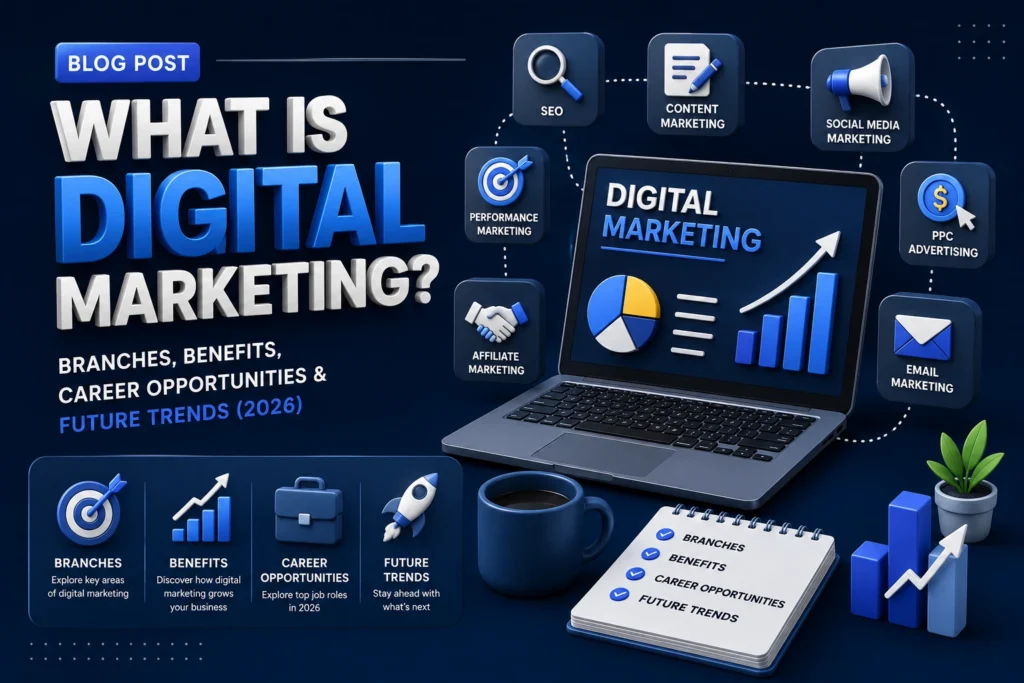
The way businesses connect with customers has changed dramatically over the past decade. Today, people search for products on Google, discover brands on social media, watch reviews on YouTube, and make purchases through websites and mobile apps. As consumer behavior continues to shift online, businesses must adapt to remain competitive. This is where digital marketing plays a crucial role.
Digital marketing is more than just posting on social media or running advertisements. It is a broad field that combines strategy, creativity, technology, and data to help businesses reach the right audience at the right time.
Whether you are a business owner looking to grow your brand or someone exploring a career in marketing, understanding digital marketing is essential in 2026. This guide explains what digital marketing is, its major branches, how it benefits businesses, available career opportunities, and the trends shaping its future.
What Is Digital Marketing?
Digital marketing refers to the promotion of products, services, or brands through online channels and digital technologies. These channels include search engines, websites, social media platforms, email, mobile applications, and online advertising networks.
Unlike traditional marketing methods such as newspapers, billboards, and television advertisements, digital marketing allows businesses to interact directly with their target audience and measure campaign performance in real time.
For example, a local restaurant can use social media marketing to attract nearby customers, while an e-commerce business can use search engine optimization (SEO) to appear in Google search results when potential buyers look for relevant products.
The primary goal of digital marketing is to attract, engage, and convert potential customers into loyal clients while building long-term brand awareness.
Major Branches of Digital Marketing
Digital marketing consists of several specialized areas. Each branch serves a unique purpose and contributes to overall business growth.
1. Search Engine Optimization (SEO)
SEO is the process of improving a website’s visibility in search engine results. When users search for information, products, or services online, businesses want their websites to appear as high as possible in search rankings.
SEO involves:
- Keyword research
- Content optimization
- Technical website improvements
- Link building
- User experience optimization
A strong SEO strategy helps businesses generate organic traffic without relying entirely on paid advertising.
2. Content Marketing
Content marketing focuses on creating valuable and relevant content that educates, informs, or entertains a target audience.
Common forms of content include:
- Blog articles
- Videos
- Case studies
- Infographics
- E-books
- Podcasts
The goal is not simply to sell products but to provide value that builds trust and credibility. High-quality content also supports SEO and helps attract potential customers throughout their buying journey.
3. Social Media Marketing
Social media marketing involves promoting brands through platforms such as Instagram, Facebook, LinkedIn, TikTok, and X.
Businesses use social media to:
- Increase brand awareness
- Engage with customers
- Generate leads
- Promote products and services
- Build online communities
A successful social media strategy combines consistent content creation, audience engagement, and data-driven decision-making.
4. Pay-Per-Click (PPC) Advertising
PPC advertising allows businesses to display paid advertisements on search engines and social media platforms.
Popular PPC platforms include:
- Google Ads
- Meta Ads
- LinkedIn Ads
- TikTok Ads
Businesses pay only when users click on their advertisements. PPC campaigns can generate immediate traffic and are often used alongside SEO to maximize visibility.
5. Email Marketing
Email marketing remains one of the most effective digital marketing channels. It allows businesses to communicate directly with customers through personalized messages.
Common uses of email marketing include:
- Promotional campaigns
- Product updates
- Newsletters
- Customer retention programs
- Lead nurturing sequences
Because email reaches users directly in their inboxes, it continues to deliver strong engagement and return on investment.
6. Performance Marketing
Performance marketing focuses on measurable outcomes such as leads, sales, downloads, and conversions.
Unlike traditional advertising, where success may be difficult to measure, performance marketing relies heavily on data and analytics to optimize campaigns and improve results.
Businesses often use performance marketing to maximize return on investment while reducing unnecessary spending.
7. Affiliate Marketing
Affiliate marketing is a partnership-based marketing model where individuals or businesses promote products and receive commissions for successful sales or leads.
This approach benefits both companies and affiliates because businesses gain additional exposure while affiliates earn income from their marketing efforts.
Benefits of Digital Marketing for Businesses
Digital marketing provides numerous advantages for businesses of all sizes.
Cost-Effective Marketing
Compared to traditional advertising methods, digital marketing often requires a lower investment while reaching a larger audience.
Small businesses can compete with larger companies by using targeted digital marketing strategies instead of relying on expensive mass-media campaigns.
Better Audience Targeting
Digital marketing platforms allow businesses to target specific audiences based on factors such as:
- Age
- Location
- Interests
- Online behavior
- Purchase history
This precision helps businesses focus their marketing efforts on people most likely to become customers.
Measurable Results
One of the greatest strengths of digital marketing is its ability to track performance.
Businesses can monitor:
- Website traffic
- Click-through rates
- Conversions
- Sales
- Customer engagement
This data allows marketers to make informed decisions and continuously improve campaigns.
Increased Brand Awareness
A strong online presence helps businesses become more visible to potential customers.
Through SEO, content marketing, and social media marketing, companies can establish credibility and remain top-of-mind within their industry.
Improved Customer Engagement
Digital platforms create opportunities for direct interaction between businesses and customers.
Brands can answer questions, respond to feedback, and build stronger relationships through personalized communication.
Higher Revenue Potential
Effective digital marketing strategies generate qualified leads and increase conversion rates, ultimately contributing to business growth and profitability.
Career Opportunities in Digital Marketing (2026)
Digital marketing continues to be one of the fastest-growing career fields worldwide. As businesses invest more heavily in online channels, demand for skilled professionals remains strong.
Popular career opportunities include:
SEO Specialist
SEO specialists optimize websites to improve search rankings and increase organic traffic.
Content Writer
Content writers create blog posts, website content, articles, and other forms of written content that support marketing goals.
Social Media Manager
Social media managers develop content strategies, manage online communities, and grow brand visibility across platforms.
PPC Specialist
PPC specialists create and manage paid advertising campaigns on platforms such as Google Ads and Meta Ads.
Performance Marketer
Performance marketers focus on achieving measurable business outcomes through data-driven campaigns.
Email Marketing Specialist
These professionals create email campaigns designed to engage audiences and improve customer retention.
Digital Marketing Executive
Digital marketing executives coordinate multiple marketing activities and support overall campaign execution.
Digital Marketing Manager
Managers oversee marketing teams, strategies, budgets, and performance metrics.
Marketing Automation Specialist
These specialists use automation tools to streamline customer communication and improve marketing efficiency.
Freelance Digital Marketer
Freelancers work independently with multiple clients, offering services such as SEO, content marketing, social media management, and paid advertising.
As businesses increasingly prioritize online growth, digital marketing skills are expected to remain highly valuable throughout 2026 and beyond.
Future Trends Shaping Digital Marketing
The digital marketing landscape continues to evolve as technology advances and consumer expectations change.
Artificial Intelligence (AI)
AI is transforming marketing by helping businesses automate tasks, analyze data, generate content ideas, and improve customer experiences.
Marketers who learn to work alongside AI tools will gain a significant competitive advantage.
Personalization at Scale
Consumers increasingly expect personalized experiences.
Businesses are using customer data to deliver tailored content, recommendations, and offers that improve engagement and conversion rates.
Video-First Marketing
Video content continues to dominate digital platforms.
Short-form videos, educational content, product demonstrations, and live streaming are becoming essential components of modern marketing strategies.
Voice Search Optimization
As voice assistants become more common, businesses must adapt their SEO strategies to accommodate conversational search behavior.
Data-Driven Decision Making
Marketing decisions are increasingly based on analytics rather than assumptions.
Organizations that effectively use data will be better positioned to understand customer behavior and optimize performance.
Omnichannel Marketing
Customers interact with brands across multiple platforms.
Businesses that provide a consistent experience across websites, social media, email, and mobile applications will be more successful in building customer loyalty.
Digital marketing has become an essential part of modern business growth. Through channels such as SEO, content marketing, social media marketing, email marketing, PPC advertising, and performance marketing, businesses can reach targeted audiences, increase brand awareness, and generate measurable results.
At the same time, digital marketing offers diverse career opportunities for professionals seeking a dynamic and future-focused industry. As technologies such as artificial intelligence, automation, and advanced analytics continue to evolve, the importance of digital marketing will only increase.
Whether you are a business owner aiming to grow online or an aspiring marketer looking to build a rewarding career, understanding digital marketing is one of the most valuable investments you can make in 2026 and beyond.
About the Author
Aaroh Ravindran is a digital marketing enthusiast based in Dubai, sharing insights on SEO, content marketing, and online growth strategies through Aarohverse. He is on a journey to become one of the best digital marketing freelancers in Dubai while helping businesses build their online presence.